

The Value of Bringing Reggio Emilia to New Zealand Primary Schools
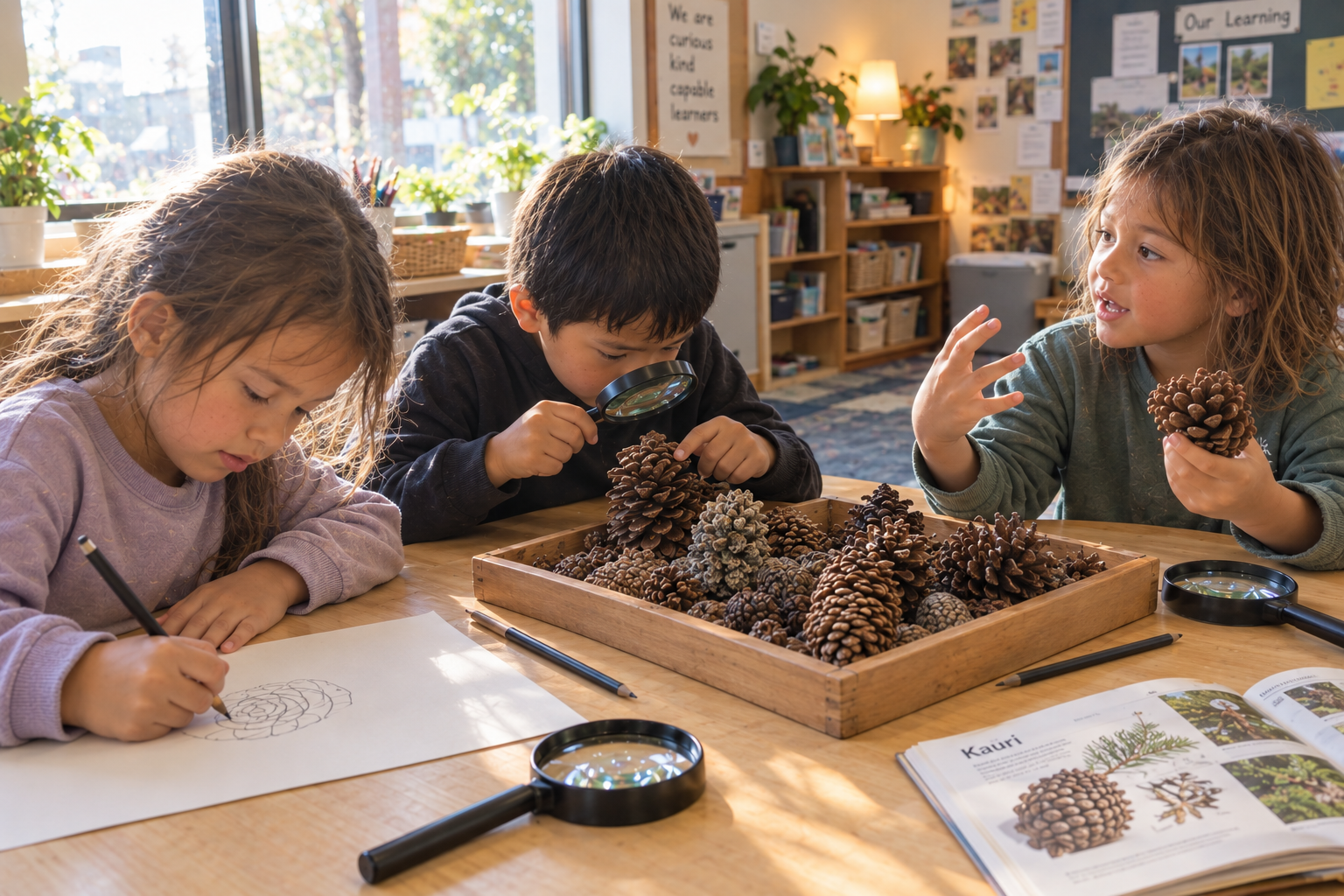
In a sun-drenched corner of a Year 1 classroom in New Zealand, a group of five-year-olds huddles around a "provocation": a collection of intricate kauri cones, magnifying glasses, and charcoal pencils. One child is meticulously sketching the spiral patterns, another is counting the scales in groups of two, and a third is spinning a story about the "forest giants" these cones came from.
This is the Reggio Emilia approach in action—a philosophy that doesn't just "teach" children but co-constructs knowledge with them. While it originated in Italy, its heartbeat is remarkably synchronous with the values of Te Whāriki and the New Zealand Curriculum (NZC).
1. The Child as a Protagonist and the 'Hundred Languages'
Loris Malaguzzi, the founder of the Reggio approach, famously wrote that a child has a hundred languages but "the school and the culture steal ninety-nine." In our NZ classrooms, we resist this theft. We recognise that while the October 2025 curriculum updates place a necessary and firm emphasis on structured literacy and mathematical foundations, these "languages" of decoding and numeracy are just two among many.
By valuing the "hundred languages"—painting, drama, construction, music—we provide multiple entry points for children to meet curriculum goals. A child might demonstrate their understanding of "belonging to groups" (Social Sciences Level 1) through a collaborative block-building project just as effectively as through a verbal discussion.
2. The Environment as the Third Teacher
In a Reggio-inspired school, the classroom is not just a room; it is the "third teacher." It is intentionally designed to be an atelier (a workshop) that stimulates inquiry.
Transparency and Light: We use natural materials and light to create a sense of calm and wonder.
Accessibility: Tools for the "hundred languages" are within reach, empowering children to choose the medium that best expresses their thinking.
Documentation: The walls are not covered in store-bought posters but in pedagogical documentation—photos, transcriptions of children's theories, and their artwork. This makes the learning visible to the children, their whānau, and the teachers, fulfilling the NZC requirement for transparency and community engagement.
3. Weaving Inquiries with Mandated Requirements
One might ask: "How do you follow the child’s lead while ensuring they learn to read and write?" The answer lies in integrated inquiry.
When our tamariki became fascinated by the birds in our school garden, we didn't pause our literacy and numeracy. Instead, the birds became our context.
Literacy: We used structured literacy approaches to decode words like "wing," "beak," and "nest". Children wrote labels for their bird sketches, practicing letter formation and phoneme-grapheme correspondences as outlined in the Phase 1 English sequence.
Mathematics: We tracked the number of tūī versus sparrows, engaging in Level 1 Statistics and Number. We measured the wingspans of different birds using non-standard units, meeting Measurement goals for Year 1.
4. A Community of Learners
The Reggio approach views the school as a "little community". This aligns perfectly with the NZC’s Key Competencies, particularly Relating to Others and Participating and Contributing. Through long-term projects, children learn to negotiate, collaborate, and value diverse perspectives—skills that are essential for lifelong learning.
Conclusion
Applying the Reggio Emilia approach in a New Zealand primary setting is not about choosing between "play" and "academics." It is about recognising that joy and rigor are partners. By honoring the child's voice and providing a rich, responsive environment, we don't just meet the standards of the New Zealand Curriculum—we bring them to life in a way that is as intricate and beautiful as the spiral of a nautilus.
